
Англійска-французская кніга-білінгва
Antoine de Saint-Exupery
The Little Prince
Antoine de Saint-Exupéry
Le Petit Prince


Once again I felt myself frozen by the sense of something irreparable. And I knew that I could not bear the thought of never hearing that laughter any more. For me, it was like a spring of fresh water in the desert.
De nouveau je me sentis glacé par le sentiment de l’irréparable. Et je compris que je ne supportais pas l’idée de ne plus jamais entendre ce rire. C’était pour moi comme une fontaine dans le désert.
“Little man,” I said, “I want to hear you laugh again.”
— Petit bonhomme, je veux encore t’entendre rire…
But he said to me:
Mais il me dit:
“Tonight, it will be a year… My star, then, can be found right above the place where I came to the Earth, a year ago…”
— Cette nuit, ça fera un an. Mon étoile se trouvera juste au-dessus de l’endroit où je suis tombé l’année dernière…
“Little man,” I said, “tell me that it is only a bad dream — this affair of the snake, and the meeting-place, and the star…”
— Petit bonhomme, n’est-ce pas que c’est un mauvais rêve cette histoire de serpent et de rendez-vous et d’étoile…
But he did not answer my plea.
Mais il ne répondit pas à ma question. Il me dit:
He said to me, instead:
“The thing that is important is the thing that is not seen…”
— Ce qui est important, ça ne se voit pas…
“Yes, I know…”
— Bien sûr…
“It is just as it is with the flower. If you love a flower that lives on a star, it is sweet to look at the sky at night. All the stars are a-bloom with flowers…”
— C’est comme pour la fleur. Si tu aimes une fleur qui se trouve dans une étoile, c’est doux, la nuit, de regarder le ciel. Toutes les étoiles sont fleuries.
“Yes, I know…”
— Bien sûr…
“It is just as it is with the water. Because of the pulley, and the rope, what you gave me to drink was like music. You remember — how good it was.”
— C’est comme pour l’eau. Celle que tu m’as donnée à boire était comme une musique, à cause de la poulie et de la corde… tu te rappelles… elle était bonne.
“Yes, I know…”
— Bien sûr…
“And at night you will look up at the stars. Where I live everything is so small that I cannot show you where my star is to be found. It is better, like that. My star will just be one of the stars, for you. And so you will love to watch all the stars in the heavens… they will all be your friends. And, besides, I am going to make you a present…”
— Tu regarderas, la nuit, les étoiles. C’est trop petit chez moi pour que je te montre où se trouve la mienne. C’est mieux comme ça. Mon étoile, ça sera pour toi une des étoiles. Alors, toutes les étoiles, tu aimeras les regarder… Elles seront toutes tes amies. Et puis je vais te faire un cadeau…
He laughed again.
Il rit encore.
“Ah, little prince, dear little prince! I love to hear that laughter!”
— Ah! petit bonhomme, petit bonhomme j’aime entendre ce rire!
“That is my present. Just that. It will be as it was when we drank the water…”
— Justement ce sera mon cadeau… ce sera comme pour l’eau…
“What are you trying to say?”
— Que veux-tu dire?
“All men have the stars,” he answered, “but they are not the same things for different people. For some, who are travelers, the stars are guides. For others they are no more than little lights in the sky. For others, who are scholars, they are problems. For my businessman they were wealth. But all these stars are silent. You — you alone — will have the stars as no one else has them — ”
— Les gens ont des étoiles qui ne sont pas les mêmes. Pour les uns, qui voyagent, les étoiles sont des guides. Pour d’autres elles ne sont rien que de petites lumières. Pour d’autres qui sont savants elles sont des problèmes. Pour mon businessman elles étaient de l’or. Mais toutes ces étoiles-là se taisent. Toi, tu auras des étoiles comme personne n’en a…
“What are you trying to say?”
— Que veux-tu dire?
“In one of the stars I shall be living. In one of them I shall be laughing. And so it will be as if all the stars were laughing, when you look at the sky at night… You — only you — will have stars that can laugh!”
— Quand tu regarderas le ciel, la nuit, puisque j’habiterai dans l’une d’elles, puisque je rirai dans l’une d’elles, alors ce sera pour toi comme si riaient toutes les étoiles. Tu auras, toi, des étoiles qui savent rire!
And he laughed again.
Et il rit encore.
“And when your sorrow is comforted (time soothes all sorrows) you will be content that you have known me. You will always be my friend. You will want to laugh with me. And you will sometimes open your window, so, for that pleasure…
— Et quand tu seras consolé (on se console toujours) tu seras content de m’avoir connu. Tu seras toujours mon ami. Tu auras envie de rire avec moi. Et tu ouvriras parfois ta fenêtre, comme ça, pour le plaisir…
And your friends will be properly astonished to see you laughing as you look up at the sky! Then you will say to them, ‘Yes, the stars always make me laugh!’ And they will think you are crazy. It will be a very shabby trick that I shall have played on you…”
Et tes amis seront bien étonnés de te voir rire en regardant le ciel. Alors tu leur diras: «Oui, les étoiles, ça me fait toujours rire!» Et ils te croiront fou. Je t’aurai joué un bien vilain tour…
And he laughed again.
Et il rit encore.
“It will be as if, in place of the stars, I had given you a great number of little bells that knew how to laugh…”
— Ce sera comme si je t’avais donné, au lieu d’étoiles, des tas de petits grelots qui savent rire…
And he laughed again. Then he quickly became serious:
Et il rit encore. Puis il redevint sérieux:
“Tonight — you know… Do not come.”
— Cette nuit… tu sais… ne viens pas.
“I shall not leave you,” I said.
— Je ne te quitterai pas.
“I shall look as if I were suffering. I shall look a little as if I were dying. It is like that. Do not come to see that. It is not worth the trouble…”
— J’aurai l’air d’avoir mal… j’aurai un peu l’air de mourir. C’est comme ça. Ne viens pas voir ça, ce n’est pas la peine…
“I shall not leave you.”
— Je ne te quitterai pas.
But he was worried.
Mais il était soucieux.
“I tell you — it is also because of the snake. He must not bite you. Snakes — they are malicious creatures. This one might bite you just for fun…”
— Je te dis ça… c’est à cause aussi du serpent. Il ne faut pas qu’il te morde… Les serpents, c’est méchant. Ça peut mordre pour le plaisir…
“I shall not leave you.”
— Je ne te quitterai pas.
But a thought came to reassure him:
Mais quelque chose le rassura:
“It is true that they have no more poison for a second bite.”
— C’est vrai qu’ils n’ont plus de venin pour la seconde morsure…
That night I did not see him set out on his way. He got away from me without making a sound. When I succeeded in catching up with him he was walking along with a quick and resolute step. He said to me merely:
Cette nuit-là je ne le vis pas se mettre en route. Il s’était évadé sans bruit. Quand je réussis à le rejoindre il marchait décidé, d’un pas rapide. Il me dit seulement:
“Ah! You are there…”
— Ah! tu es là…
And he took me by the hand. But he was still worrying.
Et il me prit par la main. Mais il se tourmenta encore:
“It was wrong of you to come. You will suffer. I shall look as if I were dead; and that will not be true…”
— Tu as eu tort. Tu auras de la peine. J’aurai l’air d’être mort et ce ne sera pas vrai…
I said nothing.
Moi je me taisais.
“You understand… it is too far. I cannot carry this body with me. It is too heavy.”
— Tu comprends. C’est trop loin. Je ne peux pas emporter ce corps-là. C’est trop lourd.
I said nothing.
Moi je me taisais.
“But it will be like an old abandoned shell. There is nothing sad about old shells…”
— Mais ce sera comme une vieille écorce abandonnée. Ce n’est pas triste les vieilles écorces…
I said nothing.
Moi je me taisais.
He was a little discouraged. But he made one more effort:
Il se découragea un peu. Mais il fit encore un effort:
“You know, it will be very nice. I, too, shall look at the stars. All the stars will be wells with a rusty pulley. All the stars will pour out fresh water for me to drink…”
— Ce sera gentil, tu sais. Moi aussi je regarderai les étoiles. Toutes les étoiles seront des puits avec une poulie rouillée. Toutes les étoiles me verseront à boire…
I said nothing.
Moi je me taisais.
“That will be so amusing! You will have five hundred million little bells, and I shall have five hundred million springs of fresh water…”
— Ce sera tellement amusant! Tu auras cinq cents millions de grelots, j’aurai cinq cents millions de fontaines…
And he too said nothing more, because he was crying…
Et il se tut aussi, parce qu’il pleurait…
“Here it is. Let me go on by myself.”
— C’est là. Laisse-moi faire un pas tout seul.

And he sat down, because he was afraid.
Et il s’assit parce qu’il avait peur.

Then he said, again:
Il dit encore:
“You know — my flower… I am responsible for her. And she is so weak! She is so naïve! She has four thorns, of no use at all, to protect herself against all the world…”
— Tu sais… ma fleur… j’en suis responsable! Et elle est tellement faible! Et elle est tellement naïve. Elle a quatre épines de rien du tout pour la protéger contre le monde…
I too sat down, because I was not able to stand up any longer.
Moi je m’assis parce que je ne pouvais plus me tenir debout. Il dit:
“There now — that is all…”
— Voilà… C’est tout…
He still hesitated a little; then he got up. He took one step. I could not move.
Il hésita encore un peu, puis il se releva. Il fit un pas. Moi je ne pouvais pas bouger.
There was nothing but a flash of yellow close to his ankle. He remained motionless for an instant. He did not cry out. He fell as gently as a tree falls. There was not even any sound, because of the sand.
Il n’y eut rien qu’un éclair jaune près de sa cheville. Il demeura un instant immobile. Il ne cria pas. Il tomba doucement comme tombe un arbre. Ça ne fit même pas de bruit, à cause du sable.

XXVII
CHAPITRE XXVII
And now six years have already gone by… I have never yet told this story. The companions who met me on my return were well content to see me alive. I was sad, but I told them: “I am tired.”
Et maintenant, bien sûr, ça fait six ans déjà… Je n’ai jamais encore raconté cette histoire. Les camarades qui m’ont revu ont été bien contents de me revoir vivant. J’étais triste mais je leur disais: «C’est la fatigue…»
Now my sorrow is comforted a little. That is to say — not entirely. But I know that he did go back to his planet, because I did not find his body at daybreak. It was not such a heavy body… and at night I love to listen to the stars. It is like five hundred million little bells…
Maintenant je me suis un peu consolé. C’est à dire… pas tout à fait. Mais je sais bien qu’il est revenu à sa planète, car, au lever du jour, je n’ai pas retrouvé son corps. Ce n’était pas un corps tellement lourd… Et j’aime la nuit écouter les étoiles. C’est comme cinq cent millions de grelots…
But there is one extraordinary thing… when I drew the muzzle for the little prince, I forgot to add the leather strap to it. He will never have been able to fasten it on his sheep. So now I keep wondering: what is happening on his planet? Perhaps the sheep has eaten the flower…
Mais voilà qu’il se passe quelque chose d’extraordinaire. La muselière que j’ai dessinée pour le petit prince, j’ai oublié d’y ajouter la courroie de cuir! Il n’aura jamais pu l’attacher au mouton. Alors je me demande: «Que s’est-il passé sur sa planète? Peut-être bien que le mouton a mangé la fleur…»
At one time I say to myself: “Surely not! The little prince shuts his flower under her glass globe every night, and he watches over his sheep very carefully…” Then I am happy. And there is sweetness in the laughter of all the stars.
Tantôt je me dis: «Sûrement non! Le petit prince enferme sa fleur toutes les nuits sous son globe de verre, et il surveille bien son mouton…» Alors je suis heureux. Et toutes les étoiles rient doucement.
But at another time I say to myself: “At some moment or other one is absent-minded, and that is enough! On some one evening he forgot the glass globe, or the sheep got out, without making any noise, in the night…” And then the little bells are changed to tears…
Tantôt je me dis: «On est distrait une fois ou l’autre, et ça suffit! Il a oublié, un soir, le globe de verre, ou bien le mouton est sorti sans bruit pendant la nuit…» Alors les grelots se changent tous en larmes!…
Here, then, is a great mystery. For you who also love the little prince, and for me, nothing in the universe can be the same if somewhere, we do not know where, a sheep that we never saw has — yes or no? — eaten a rose…
C’est là un bien grand mystère. Pour vous qui aimez aussi le petit prince, comme pour moi, rien de l’univers n’est semblable si quelque part, on ne sait où, un mouton que nous ne connaissons pas a, oui ou non, mangé une rose…
Look up at the sky. Ask yourselves: is it yes or no? Has the sheep eaten the flower? And you will see how everything changes…
Regardez le ciel. Demandez-vous: le mouton oui ou non a-t-il mangé la fleur? Et vous verrez comme tout change…
And no grown-up will ever understand that this is a matter of so much importance!
Et aucune grande personne ne comprendra jamais que ça a tellement d’importance!
This is, to me, the loveliest and saddest landscape in the world. It is the same as that on the preceding page, but I have drawn it again to impress it on your memory. It is here that the little prince appeared on Earth, and disappeared.
Ça c’est, pour moi, le plus beau et le plus triste paysage du monde. C’est le même paysage que celui de la page précédente, mais je l’ai dessiné une fois encore pour bien vous le montrer. C’est ici que le petit prince a apparu sur terre, puis disparu.
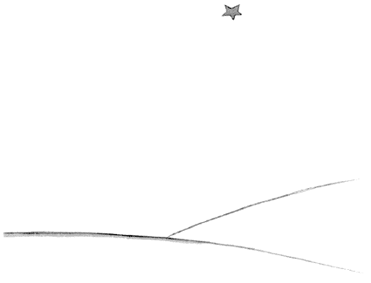
Look at it carefully so that you will be sure to recognize it in case you travel some day to the African desert. And, if you should come upon this spot, please do not hurry on. Wait for a time, exactly under the star.
Regardez attentivement ce paysage afin d’être sûrs de le reconnaître, si vous voyagez un jour en Afrique, dans le désert. Et, s’il vous arrive de passer par là, je vous en supplie, ne vous pressez pas, attendez un peu juste sous l’étoile!
Then, if a little man appears who laughs, who has golden hair and who refuses to answer questions, you will know who he is. If this should happen, please comfort me. Send me word that he has come back.
Si alors un enfant vient à vous, s’il rit, s’il a des cheveux d’or, s’il ne répond pas quand on l’interroge, vous devinerez bien qui il est. Alors soyez gentils! Ne me laissez pas tellement triste: écrivez-moi vite qu’il est revenu…
1943
1943
Рэклама